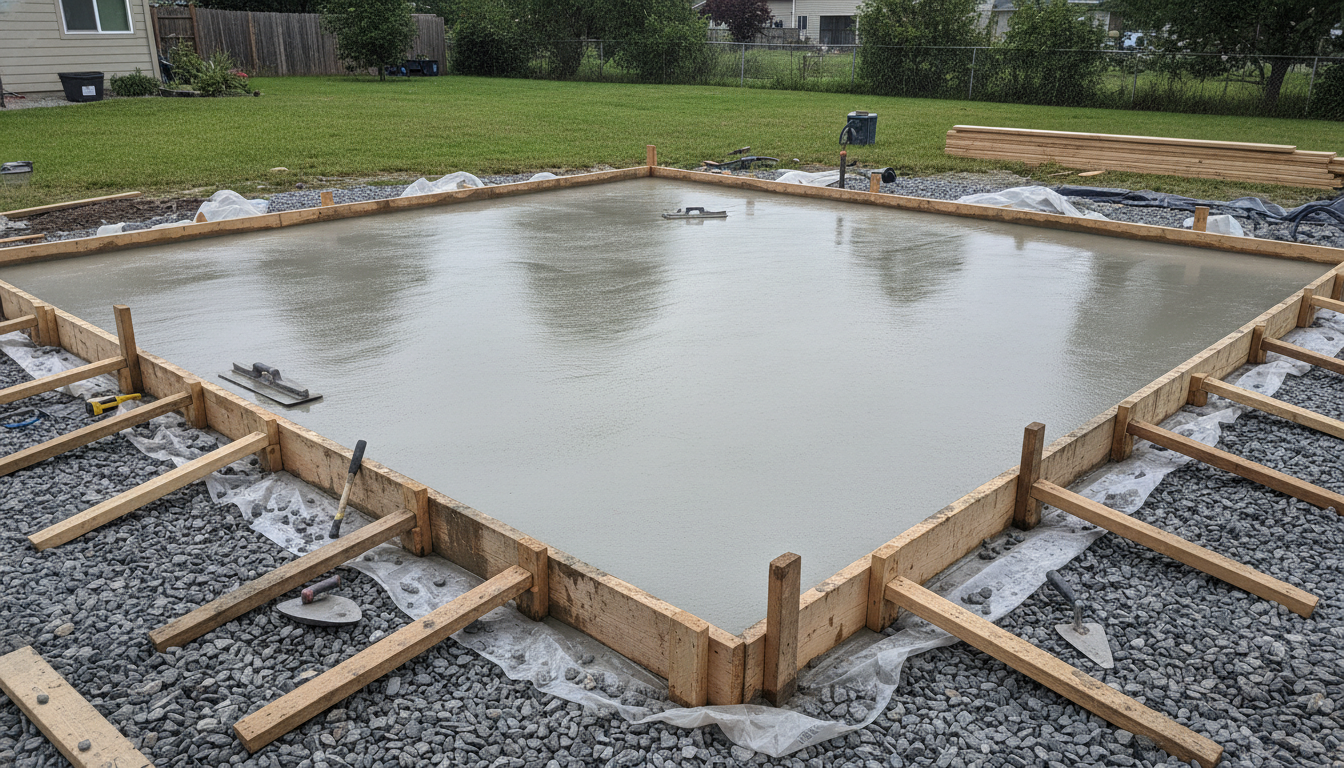
Whether you are pouring a simple backyard patio, setting post footings for a new deck, or laying the foundation for a garden shed, ordering the correct amount of concrete is critical. Order too little, and you face the disaster of a cold joint where fresh wet concrete is poured against a batch that has already begun to set, creating a weak structural seam. Calling the ready-mix supplier for an urgent delivery of half a cubic yard will also trigger steep short-load fees.
On the flip side, over-ordering wastes money and leaves you with hundreds of pounds of rapidly hardening wet slurry to dispose of before it damages your lawn or driveway. Getting your concrete measurements exact requires a solid understanding of volume calculations, unit conversions, and realistic waste margins. In this guide, we will break down the precise formulas you need, walk through a real-world calculation example, and show you how to streamline your project planning.
Understanding Concrete Volume Formulas
Concrete is sold and measured by volume rather than weight. In the United States, bulk concrete delivered by ready-mix trucks is measured in cubic yards, while pre-bagged concrete mix is measured in cubic feet or bag yields. Understanding how to convert between inches, feet, and yards is essential for accurate ordering.
For standard flat slabs, pads, and driveways, the basic volume formula relies on three main dimensions: Volume = Length × Width × Depth.
Because slab thickness is almost always measured in inches while length and width are measured in feet, you must convert the depth measurement into feet before multiplying. To do this, divide the depth in inches by 12.
Convert depth to feet: Depth (in inches) ÷ 12 = Depth (in feet)
Convert to cubic yards: Volume (cu ft) ÷ 27 = Volume (cu yd)
Worked Example: Calculating Concrete for a DIY Patio Slab
Let us walk through a practical example to see how this works in real life. Imagine you plan to pour an outdoor patio slab that measures 12 feet long, 10 feet wide, and 4 inches deep.
Here is how to calculate the exact volume required step by step:
Step 1: Convert depth from inches to feet. 4 inches ÷ 12 = 0.333 feet.
Step 2: Calculate the volume in cubic feet. 12 feet × 10 feet × 0.333 feet = 39.96 cubic feet (rounded to 40 cu ft).
Step 4: Add a safety cushion (overage margin). Never order the exact theoretical volume. Formwork can flex under pressure, the subbase gravel is rarely perfectly flat, and small amounts of material always remain stuck inside the mixer, wheelbarrow, or chute. It is industry standard to add a 10% waste buffer to your total.
1.48 cubic yards × 1.10 = 1.63 cubic yards
If ordering from a ready-mix supplier, they usually round up to the nearest quarter or half-yard, so you would order 1.75 cubic yards of concrete.
Bags vs. Bulk: Choosing the Right Supply Option
For smaller home projects, buying pre-mixed concrete bags from a local home improvement center is often more economical than paying for a ready-mix truck delivery. Standard bagged concrete mix yields specific volumes based on weight:
80 lb bag: Yields approximately 0.60 cubic feet
60 lb bag: Yields approximately 0.45 cubic feet
40 lb bag: Yields approximately 0.30 cubic feet
Using our 12 ft × 10 ft patio example (which required 40 cubic feet of material, plus 10% for waste = 44 cubic feet total), here is how many bags you would need:
44 cu ft ÷ 0.60 cu ft per 80 lb bag = 74 bags
44 cu ft ÷ 0.45 cu ft per 60 lb bag = 98 bags
Mixing nearly 75 heavy bags by hand is an exhausting physical task. As a general rule, if your project requires more than 1 cubic yard (roughly 45 to 50 eighty-pound bags), calling a ready-mix delivery or renting a towable mixer becomes well worth the investment.
Streamline Your Planning with CalcHub
While doing manual math helps you understand the mechanics of materials, crunching numbers on a dusty construction site often leads to unnecessary mistakes. Instead of manually converting fractions and factoring in complex safety margins on scratch paper, you can plug your exact project dimensions into the Concrete Volume Calculator on CalcHub. It instantly calculates total cubic feet, cubic yards, and the exact number of 40-lb, 60-lb, or 80-lb pre-mixed bags needed, automatically incorporating your customized waste percentage for error-free planning.
Key Tips to Avoid Common Concrete Mistakes
Account for Excavation Depth: If you dig a 6-inch deep excavation and add a 2-inch crushed gravel base, your concrete pour depth is 4 inches, not 6 inches. Always measure concrete depth from the compacted gravel surface to the top of your formwork.
Brace Your Formwork: Wet concrete exerts massive hydrostatic pressure. If your wood forms bow outward by even half an inch along a 12-foot span, it will consume significantly more concrete volume than calculated.
Factor in Complex Footings: For circular footings or slab edges with thickened perimeter beams, break the total pour down into simpler geometric shapes like rectangles and cylinders, calculating each section separately before summing them up.
Conclusion
Accurate concrete volume calculations save time, eliminate physical strain, and prevent unexpected expenses on pour day. By measuring carefully, adding a standard 10% safety buffer for subbase variations, and utilizing digital calculation tools before ordering materials, you can ensure your hard work results in a durable, professional finish that stands the test of time.